Screen Time And Kids: How Much Is Too Much at Each Age
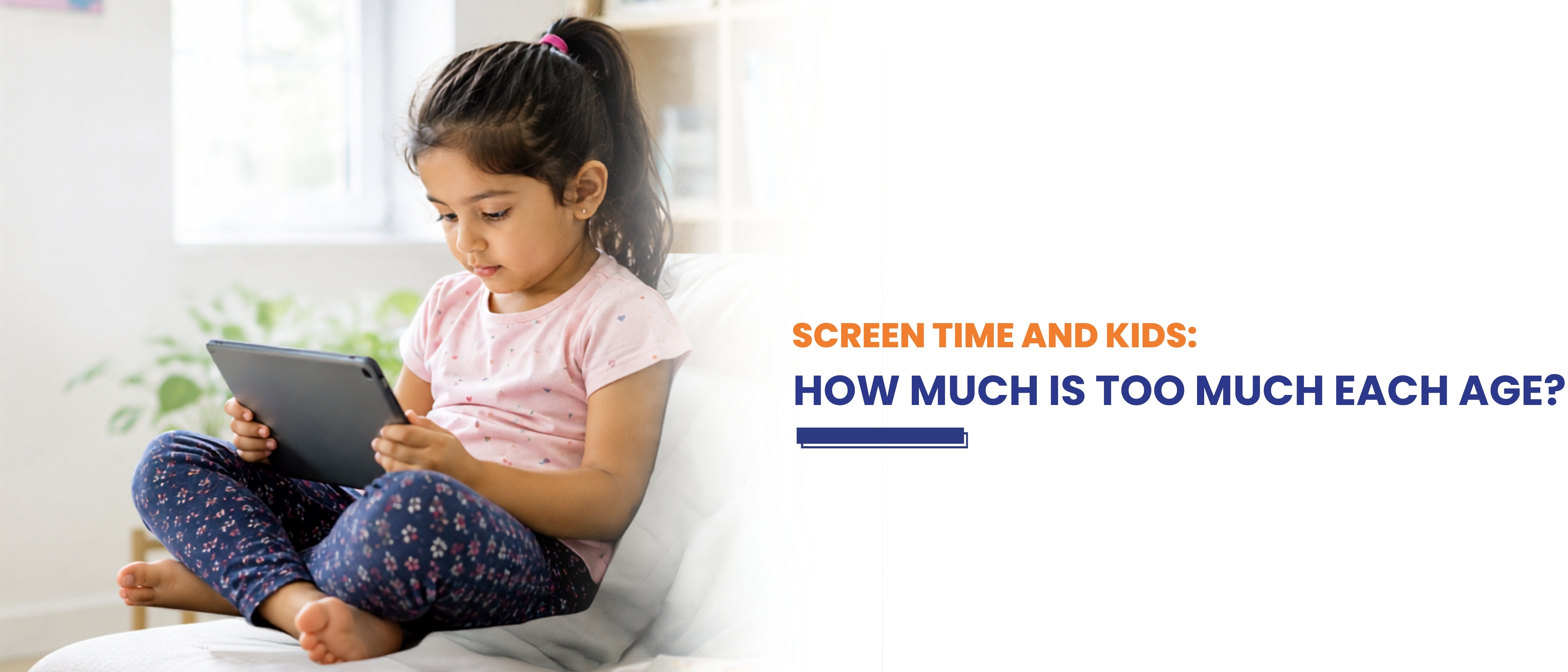
Screen Time and Kids: How Much Is Too Much at Each Age?
Screens are now part of almost every child's daily life. Children use phones, tablets, televisions, and computers for entertainment, schoolwork, video calls, and learning. For parents, the challenge is no longer simply whether children should use screens.
The bigger question is how much screen time is appropriate at each age and when does it start affecting a child's health?
Screen time itself is not always harmful. What matters is the child's age, what they are watching or doing, whether an adult is involved, and whether screens are replacing sleep, physical activity, learning, play, or family interaction.
For babies and toddlers, screen exposure should be very limited and should not replace face-to-face interaction. For children aged 2 to 5 years, around 1 hour a day of high-quality recreational screen content is a useful general benchmark. For older children and teenagers, there is no single number that suits everyone. Parents should focus on whether screens interfere with sleep, exercise, schoolwork, family time, and emotional wellbeing.
Why Screen Time Matters for Children
A child's brain develops rapidly during the early years.
Young children learn through:
- Talking with parents
- Listening to stories
- Playing
- Touching and exploring objects
- Physical movement
- Interacting with other children
- Observing facial expressions
A screen cannot fully replace these real-world experiences.
As children grow older, technology can become useful for learning and communication. The goal is therefore not necessarily to eliminate screens, but to create a healthy relationship with technology.
How Much Screen Time Is Appropriate at Each Age?
Screen use should change as children grow.
Under 18 Months
For babies, real-world interaction is especially important.
Routine recreational screen exposure should generally be avoided. Video calls with family members can be an exception because they involve social interaction, particularly when a parent participates.
Instead, babies benefit from:
- Talking
- Singing
- Reading
- Floor play
- Eye contact
- Exploring their surroundings
A phone or tablet should not routinely become the main tool for keeping a baby occupied.
18 to 24 Months
If parents introduce digital media during this stage, choose high-quality, age-appropriate content.
Whenever possible, watch it together.
Parents can ask questions such as:
- "What is the animal doing?"
- "Can you find the red ball?"
- "Where is the dog?"
This turns passive watching into a more interactive experience.
Avoid leaving toddlers alone with unrestricted videos or automatically playing content.
2 to 5 Years
For preschool-aged children, a useful general target is around 1 hour per day of high-quality recreational screen content.
The quality of the content matters.
Prefer:
- Educational programmes
- Age-appropriate stories
- Creative activities
- Interactive learning
- Content without frightening or inappropriate material
Whenever possible, parents should watch or play together and connect what children see on screen with real-life activities.
5 to 12 Years
Once children enter school, setting one universal daily number becomes more difficult.
A child may already use screens for:
- School assignments
- Online learning
- Research
- Communication
- Entertainment
Instead of counting every minute, parents should look at the bigger picture.
Ask: Is screen use affecting my child's sleep, exercise, studies, friendships, or family time?
Recreational screen time should have clear boundaries and should not replace essential daily activities.
Teenagers
Phones and social media become increasingly important during adolescence.
For teenagers, healthy screen use involves more than simply counting hours.
Parents should pay attention to:
- Late-night phone use
- Social media habits
- Gaming
- Online safety
- Cyberbullying
- Exposure to inappropriate content
- Changes in mood
- Reduced physical activity
- Sleep disruption
Teenagers benefit from reasonable boundaries combined with open conversations rather than rules based only on punishment.
Screen Time by Age: Quick Guide
| Age | General Approach |
|---|---|
| Under 18 months | Avoid routine recreational screens; video calls can be an exception |
| 18 to 24 months | Limited, high-quality content with an adult |
| 2 to 5 years | Around 1 hour/day of quality recreational content |
| 5 to 12 years | Set consistent limits so screens don't replace sleep, exercise, studies, or family time |
| Teenagers | Focus on balance, sleep, online safety, social media habits, and healthy boundaries |
These are general guidelines rather than strict medical rules for every child. Individual needs may vary.
What Happens When Children Get Too Much Screen Time?
Excessive screen use does not affect every child in the same way. However, unhealthy screen habits may be associated with several concerns.
Sleep Problems
Screens used close to bedtime can make it harder for children to settle down and sleep.
Late-night gaming, messaging, or video watching can also reduce total sleep time.
Poor sleep can affect:
- Concentration
- Learning
- Mood
- Behavior
- Energy levels
Keeping phones and tablets away from the bed can help.
Reduced Physical Activity
Time spent sitting on a screen can replace outdoor play and exercise.
Children need regular movement for:
- Bone health
- Muscle development
- Healthy weight
- Coordination
- Cardiovascular health
Encourage outdoor play, sports, walking, cycling, or other appropriate activities.
Eye Strain
Long periods of close-up screen use can contribute to:
- Eye tiredness
- Dry eyes
- Headaches
- Blurred vision
Regular breaks and spending time outdoors are helpful.
Encourage children to look away from the screen regularly rather than continuously focusing at a short distance.
Behavior and Emotional Wellbeing
Some children become irritable when screens are removed.
Parents may notice:
- Frequent arguments about devices
- Difficulty stopping games
- Reduced interest in other activities
- Constant requests for a phone
- Mood changes after screen use
These behaviors do not automatically mean a child has an addiction, but they may indicate that screen habits need adjustment.
Attention and Learning
Fast-moving entertainment can be highly stimulating.
Problems may arise when screens begin replacing:
- Reading
- Homework
- Creative play
- Conversation
- Problem-solving
- Real-world exploration
Educational screen content can be useful, but digital learning should complement rather than completely replace other forms of learning.
Is Educational Screen Time Different?
Yes, but the label "educational" does not automatically make unlimited screen time healthy.
A child attending an online class is using technology differently from a child watching short videos continuously.
Parents should consider:
- Purpose: Why is the child using the screen?
- Content: What are they watching?
- Context: Are they watching alone or with someone?
- Impact: What activity is screen time replacing?
A good educational app cannot replace sleep, outdoor play, family conversation, or physical activity.
Should Children Use Screens While Eating?
Whenever possible, keep regular family meals screen-free.
Eating while watching videos can distract children from hunger and fullness signals.
Screen-free meals also provide an opportunity for:
- Family conversation
- Social interaction
- Learning table habits
- Mindful eating
Parents can also model this behavior by keeping their own phones away during meals.
What About Screens Before Bed?
Bedrooms are one of the most important places to set boundaries.
Consider creating a family rule where phones, tablets, gaming devices, and televisions are switched off at least one hour before bedtime.
Charging devices outside the child's bedroom can also reduce late-night use.
A predictable bedtime routine might include:
Dinner → quiet play → bath → reading → sleep
Rather than:
Dinner → phone → videos → gaming → sleep
Signs Your Child May Be Getting Too Much Screen Time
Rather than focusing only on hours, watch for changes in everyday life.
Screen use may need attention if your child:
- Regularly loses sleep because of devices
- Avoids outdoor activities
- Becomes extremely upset when the device is removed
- Stops enjoying hobbies they previously liked
- Uses screens during almost every meal
- Struggles to complete schoolwork because of gaming or social media
- Secretly uses devices late at night
- Withdraws from family or friends
- Complains frequently of headaches or tired eyes
Persistent changes deserve a conversation with your child's doctor.
How Can Parents Reduce Screen Time Without Daily Arguments?
Suddenly removing every device often creates conflict.
Gradual, predictable boundaries tend to work better.
Create Screen-Free Zones
Keep certain places and situations screen-free, such as:
- The dining table
- Family conversations
- Bedrooms at night
Create Screen-Free Times
For example:
- During meals
- During homework
- Before school
- One hour before bedtime
Give Children Alternatives
Simply saying "put the phone away" may not work if there is nothing else to do.
Offer alternatives such as:
- Outdoor play
- Drawing
- Books
- Board games
- Music
- Sports
- Helping with cooking
- Family activities
Use Parental Controls
Age-appropriate parental controls can help manage:
- App downloads
- Inappropriate websites
- Purchases
- Content ratings
- Usage limits
Technology should support parenting, not replace supervision.
Parents Need Screen Rules Too
Children notice adult behavior.
It becomes difficult to tell a child to put away their phone when adults constantly check messages during dinner.
Try family-wide rules such as:
- No phones during meals
- No devices during family conversations
- Phones charge outside bedrooms overnight
When everyone follows the same basic rules, children are less likely to feel singled out.
CMH Expertise and Approach
At Chinmaya Mission Hospital, pediatric care looks at the child's overall development rather than screen time alone.
The pediatric team can help parents understand concerns related to sleep, behavior, growth, physical activity, learning, vision, and developmental milestones. Guidance is personalized according to the child's age, daily routine, and individual needs.
When Should You Speak to a Pediatrician?
Consider discussing screen habits with your child's doctor if:
- Screen use repeatedly interferes with sleep
- Your child has frequent headaches or eye discomfort
- There are significant behavioral changes
- Your child becomes extremely distressed without a device
- School performance has noticeably declined
- Your child avoids physical or social activities
- You have concerns about speech or developmental milestones
- Social media appears to be affecting your teenager's emotional wellbeing
A pediatrician can help determine whether screen use is the main concern or whether another health, behavioral, developmental, or emotional issue needs evaluation.
Quick FAQs
How much screen time should a 2-year-old have?
Screen exposure should remain limited. When digital media is introduced, choose high-quality content and watch together rather than leaving the child alone with a device.
How much screen time is recommended for a 5-year-old?
Around one hour of quality recreational screen content is a useful general benchmark for preschool-aged children. As children enter school, maintaining balance with sleep, physical activity, and learning becomes increasingly important.
Is 3 hours of screen time too much for a child?
It depends on the child's age, what the screen is being used for, and what activities it is replacing. Three hours of recreational use that regularly interferes with sleep, exercise, schoolwork, or relationships is a reason to review the child's routine.
Does screen time cause speech delays?
Screen use alone does not explain every speech delay. However, excessive passive screen exposure can replace valuable talking and face-to-face interaction. Parents concerned about their child's speech should seek developmental assessment rather than assuming screens are the only cause.
Is watching TV better than using a mobile phone?
The type of content, duration, viewing distance, and whether an adult participates all matter. Neither television nor smartphones should replace sleep, exercise, play, or social interaction.
Should children have phones in their bedrooms at night?
Keeping devices outside the bedroom can help prevent late-night use and protect sleep routines.
Healthy screen use is not about making children afraid of technology or banning every device.
Digital tools will continue to be part of education, communication, and everyday life.
The goal is to teach children that screens have a place, but they should not replace sleep, physical activity, learning, creativity, friendships, and family time.
By setting age-appropriate boundaries early and modelling healthy digital habits at home, parents can help children build a healthier relationship with technology.
Guided by "Healing hands, serving hearts", Chinmaya Mission Hospital remains committed to supporting children and families with compassionate, patient-centered pediatric care.
Expert Pediatric Care
Dr Pooja Doddikoppad
MBBS, MD (Pediatrics)
Experience: 10+ Years
Specialty: Pediatrics
With over 10 years of experience, Dr Pooja Doddikoppad creates a warm and welcoming environment for children, helping parents feel confident about their child's health and guiding them with gentle expertise toward lifelong wellness and healthy development.
Visit: www.cmhblr.com
Call or WhatsApp: +91 802 502 6100
Address:
Chinmaya Mission Hospital
1/1, CMH Road, Indiranagar, Bengaluru 560038
- Hits: 59
